
A class that got me thinking
I recently taught a class on handling negative emotions – our own and other people’s. Most of the audience jumped right in, sharing stories and writing down strategies. But two participants just couldn’t “get it.” Every example turned into another reason why things wouldn’t work, and every suggestion I offered was met with dismissal.
Now, I wasn’t judging them – far from it. I was empathizing; pondering what it would be like to have a true Eeyore mindset. I was also reminded of a basic human fact: some of us are wired for optimism, and others…well, not so much.
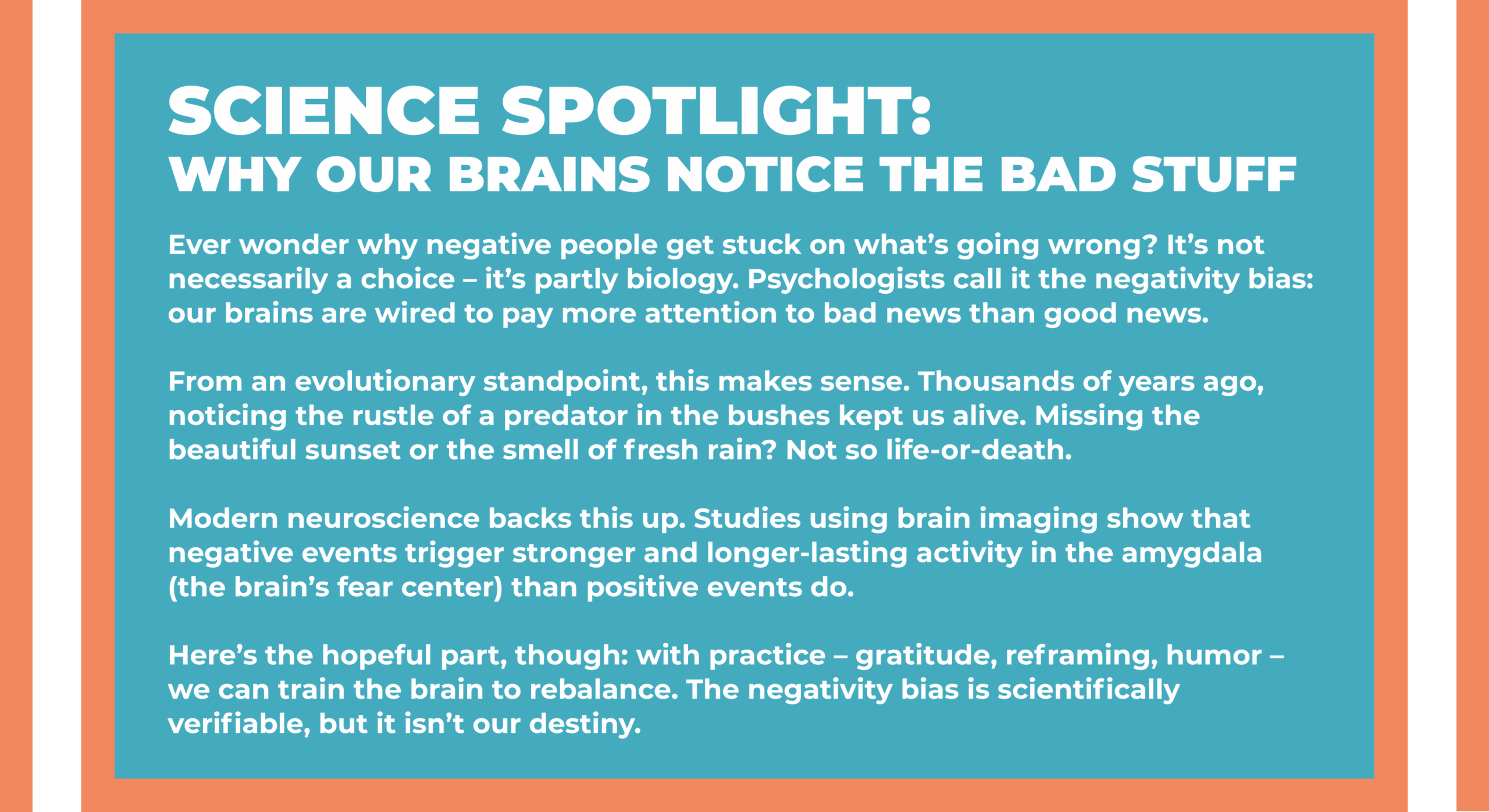
Research backs this up. Studies in psychology and neuroscience suggest that our positivity baseline is partly genetic and partly shaped by early experiences. Some brains show more activity in regions like the left prefrontal cortex, which is linked with positive emotions and resilience, while others lean more toward the right side, which is associated with vigilance and – you guessed it – negativity bias. (More on negativity bias a bit later.)
So, what do we do when we’re faced with people whose wiring seems set to “storm cloud?” Can we reach them without sounding like we’re trying to fix them? Can we help them shift, even just slightly, toward the sunny side? Let’s explore why it’s hard, why it matters, and – most importantly – how to gently nudge those around you toward positivity, always with kindness and tact.

The problem with perpetual pessimism
Negativity isn’t just unpleasant; it’s literally contagious. Spending time with chronic complainers, critics, or gloom-and-doomers can exhaust even the most optimistic among us (me included). And it doesn’t just wear you out emotionally. Research shows that exposure to constant negativity can raise cortisol (the stress hormone), disrupt focus, and even mimic the effects of chronic stress on the brain. Yikes.
But here’s an interesting twist: negative folks rarely see themselves as negative. They’re “realists.” They’re “just being practical.” They “tell it like it is.” (Sound familiar?) This can make it tough to confront them, because from their perspective, they’re simply being pragmatic.

Why it’s so hard to encourage positivity
- People resist being told what to do. Nobody wants to hear, “You need to cheer up.” It feels dismissive and controlling.
- Negativity can be a habit. Some people fall into complaining the way others bite their nails – it’s automatic and unconscious.
- Venting feels good (temporarily). Complaining gives a short-term sense of relief, even if it drags everyone else down.
- They may be stuck in a story. Negative people often frame the world through a lens of “things never work out for me,” and breaking that narrative isn’t simple.
So, we’re left with a challenge: we want to protect ourselves from being dragged into the swamp of negativity, but we also care about these people. The goal isn’t to change their personality, but to gently shift the energy of the interaction. We want to guide conversations in a way that feels safe, un-pushy, and respectful.
Why it matters (for them and you)
Think of positivity like exercise. You don’t have to run a marathon, but if you never move your body, your health suffers. Same with attitude. A little positivity can boost relationships, improve resilience, and reduce stress.
And as for you, protecting your own mindset is just as important as encouraging others, because if you don’t, you risk slipping into the same pattern of negativity. And then guess what? You become the person other people start avoiding.
DO try this at home
Here’s the fun part: strategies you can try that don’t feel bossy, judgmental, or fake. Think of these as “gentle nudges” rather than harsh commands or preachy instructions. (Trust me, commanding or preaching aren’t gonna work.)
1. Lead with empathy
Instead of: “You’re always so negative.”
Try: “That sounds rough. What do you think might help?”
Validating someone’s feelings first lowers their defenses. Then, moving to a non-confrontational question helps shift their focus toward solutions instead of just problems. Use this formula: Acknowledgment first, gentle redirection second.
2. Model the energy you want
You can’t demand positivity, but you can demonstrate it.
- Share gratitude out loud: “I’m so glad the sun came out. Perfect timing for our walk.”
- Keep a light tone: gentle, appropriate humor is a powerful mood-changer.
- Balance their “cons” with your “pros” in a non-combative way. If they say, “This restaurant will probably be crowded,” you can reply, “True, but maybe that means the food’s great!”
3. Ask solution-oriented questions
When someone’s stuck in negativity mode, gently help them pivot:
- “Well, what’s something we could do to make it better?”
- “What’s worked for you in the past?”
- “If it did go right, what would the outcome look like?”
Questions feel collaborative rather than controlling. They invite reflection instead of defensiveness.
4. Use the “Yes, and…” trick
This one’s straight outta improv comedy, and it works here, too. You validate, and then you redirect.
- Them: “This project’s a disaster.”
- You: “Yes, it’s a challenge, and we’ve got a great team.”
You’re not denying their point, but you’re steering it toward a more hopeful angle.
5. Reframe gently
I’ve had audience members argue with me about this, so let me set the record straight: reframing is not about sugarcoating. It’s about opening the lens a little wider and offering an alternative view:
- From: “I hate Mondays.”
- To: “I don’t love Mondays either, but hey, at least we get a new start.”
Or:
- From: “That traffic was horrible.”
- To: “Yeah, but it gave me time to finish a really fun podcast I’m listening to.”
You’re not sugarcoating – you’re simply offering another perspective. And over time, reframes can become contagious.

6. Protect your boundaries
If someone is chronically negative and nothing helps, you may need to limit exposure. This doesn’t have to be dramatic:
- Change the subject when complaining spirals.
- Excuse yourself politely: “I’ve got to finish this before lunch, so let’s talk later.”
- Reduce how often you engage if it’s dragging you down.
Boundaries protect your mental health. It’s not rude – it’s self-care.
7. Reinforce the positive
When your negative friend or coworker does manage to be upbeat – even for a moment – be sure to acknowledge it.
- “I love how you handled that – it was so constructive.”
- “You’re right! That’s such a good thing to focus on.”
Positive reinforcement works on adults in the same way it works on your children or your Golden Retriever: it encourages them to keep doing more of the same.
8. Don’t take the bait
Negative people sometimes thrive on pulling others into their gloom. Resist the urge to argue or defend, and for heaven’s sake, don’t match their energy. (Remember, negativity is contagious, so you must be vigilant.) Instead, respond calmly, then pivot.
- Them: “This is never going to work.”
- You: “Maybe not, but it’ll be interesting to see what happens. On another subject, did you hear…”
You can disengage without dismissing.
Remember: you don’t have to dive into every complaint spiral. Sometimes the best response is a calm nod and a subject change.
Just a couple don’ts to keep in mind
- Don’t lecture. Nobody likes a positivity sermon.
- Don’t dismiss feelings or minimize their struggles. “Just cheer up!” is the fastest way to lose them.
- Don’t fake it. Forced positivity is as irritating as constant complaining.
The takeaway
Helping negative people become more positive is a very worthy goal. It’s about gently shifting the conversation, modeling a healthier outlook, and protecting your own well-being in the process.
You’re not trying to turn someone into an eternal optimist. You’re just planting seeds – small nudges, compassionate reframes, tiny shifts in focus. And even if they never become sunshine spreaders, you’ve kept your own balance intact.
I’ve saved the very best news for last: positivity is equally contagious! Sometimes, all it takes is one person noticing what’s going right for the whole room to shift…and that person could be you!