

I was in the grocery store the other day, minding my own business in the produce section (which is where all good metaphors begin), and here’s what I observed: A mom was shopping with her two kids. The little girl, maybe six or seven, was holding a list and loudly calling out items like she was a carnival barker: “Carrots – here! Apples – yes! Granola bars – next!” Her younger brother, maybe four, was proudly pushing the cart like a tiny linebacker. The entire process was almost painfully slow, but the mom wasn’t rushing or multitasking. She was present, smiling, and guiding them gently.
And I thought, Wow. This is the opposite of the “me first” mindset we see so much of today. That moment was all about togetherness. Teaching, participating, connecting. This mom was conducting a mini masterclass in “we,” right there in the grocery store, in real time.
We live in a world that’s deeply focused on the individual. You do you. Be your own boss. Be a brand. Find yourself. Sell yourself. And while there’s certainly nothing wrong with self-expression and personal growth – two things I actively encourage in both my personal and professional life – this cultural obsession with doing it alone can sometimes leave us feeling, well…kinda lonely.
So, let’s talk about how we can gradually, lovingly, and maybe even playfully start to shift from “me” to “we.”
The individualism epidemic (and why it’s making us lonely)
In the Western world, especially in the U.S., we’ve elevated the rugged individualist to near superhero status. The bootstraps narrative is everywhere: “I did this by myself,” “No one helped me,” “I’m a self-made success story!” And again, some of that is totally valid.
We should celebrate effort, innovation, and perseverance.
But we often forget that most real success stories include some kind of support crew – friends, mentors, communities, or simply the person back home who made you your sandwich while you were dreaming your big dream.
Research backs this up. Studies published in the Journal of Cross-Cultural Psychology and other peer-reviewed journals have found that people living in more individualistic societies tend to report higher levels of loneliness, anxiety, and even depression. It turns out that when we focus too much on independence, we can end up isolated. (And eating that metaphorical sandwich alone in the dark. No fun.)

Ancient wisdom, modern relevance
This isn’t a new problem. Philosophers have been talking about the balance between self and society for millennia, and many of their ideas are super relevant for today’s world. And yes, I’m about to describe a few philosophical principles here, so please stay with me, even if you hated your philosophy class back in high school! (I promise that I’m much more entertaining than crabby old Mr. Steinhart ever was…)
Ready for a quick philosophy refresher course, presented in 45 seconds?
Let’s start with Confucius. He believed that who we are is shaped by our relationships. He emphasized roles: parent, child, friend, teacher. These roles weren’t seen as constraints, but as opportunities – chances to express care, build harmony, and live a meaningful life by being a good participant in society.
In other words: you don’t lose yourself when you connect to others. On the contrary, you find yourself.
Next, there’s Ubuntu. This beautiful South African philosophy is often translated as, “I am because we are.” It’s the belief that our humanity is wrapped up in the humanity of others. It’s not about dissolving your identity into a crowd; it’s about recognizing that your wellbeing is tied to the wellbeing of the people around you.
When Archbishop Desmond Tutu talked about Ubuntu, he described it as the essence of being human. Someone with Ubuntu is open and available to others, affirming of others, and feels secure enough in themselves to support the success of others without feeling diminished.
Before we continue, I invite you to please pause for a moment. Imagine how different our lives (and the world’s political environment) could be if that was the cultural default.

What “we” looks like in everyday life
OK, you might be saying to yourself, this is all very lovely and all that, but I can’t just run around quoting Confucius or Desmond Tutu (BTW, you actually could!), so how can I, one tiny person, effect a change?
Glad you asked! Here are a few small shifts we can all make to cultivate more connection, community, and good ol’ fashioned kindness:
1. Start with the basics: eye contact and a smile
I know it sounds tiny. But when you smile at someone – whether it’s your spouse, your neighbor, your cashier, or that mysterious man who takes his parakeet for walks – you’re making a meaningful social connection with them. (I’ve written way too many articles on the benefits of smiling, so I’ll spare you the details here, but just know that smiling is beneficial for both the smiler and the smilee.)
2. Practice generous listening
Most of us listen just long enough to figure out what we’re going to say next. (Spoiler alert: that’s not actually listening!) Instead, do your best to listen with curiosity, not just politeness. Ask follow-up questions. Nod like you mean it. People light up when they feel truly heard.
3. Celebrate collective wins
Whether it’s a group project at work, a family DIY project in your back yard, or your book club finally agreeing on this month’s one book, share the spotlight. Acknowledge everyone who participated in the process.
4. Volunteer (or just be neighborly)
You don’t need to join a giant organization. Sometimes community starts with noticing: who needs a ride? Who just had a baby and could use a casserole? Who’s been a little quiet lately and might want to chat? Little gestures, big impact.
5. Make room for everyone at the table
Inclusivity isn’t just a buzzword; it’s a way of life. Be the person who welcomes, invites, and uplifts. Not just because it’s “nice,” but because it builds a better world. And because you never know whose life you might change with a simple, “Wanna join us?”

The science of togetherness
Just in case you’re wondering… yes, all of this is backed by solid research! (You knew I would eventually share the science, right?)
Social connection has been linked to lower rates of anxiety and depression, improved immune function, and even longer lifespan. Furthermore, people who feel connected to others tend to recover from illness more quickly, cope better with stress, and generally feel happier and more fulfilled.
Conversely, one meta-analysis from Brigham Young University found that a lack of social connection is as damaging to our health as smoking 15 cigarettes a day. Yikes.
So, when we prioritize relationships, we’re making a smart investment in our health and longevity.

DO try this at home!
Here are five simple ways to shift from “me” to “we.”
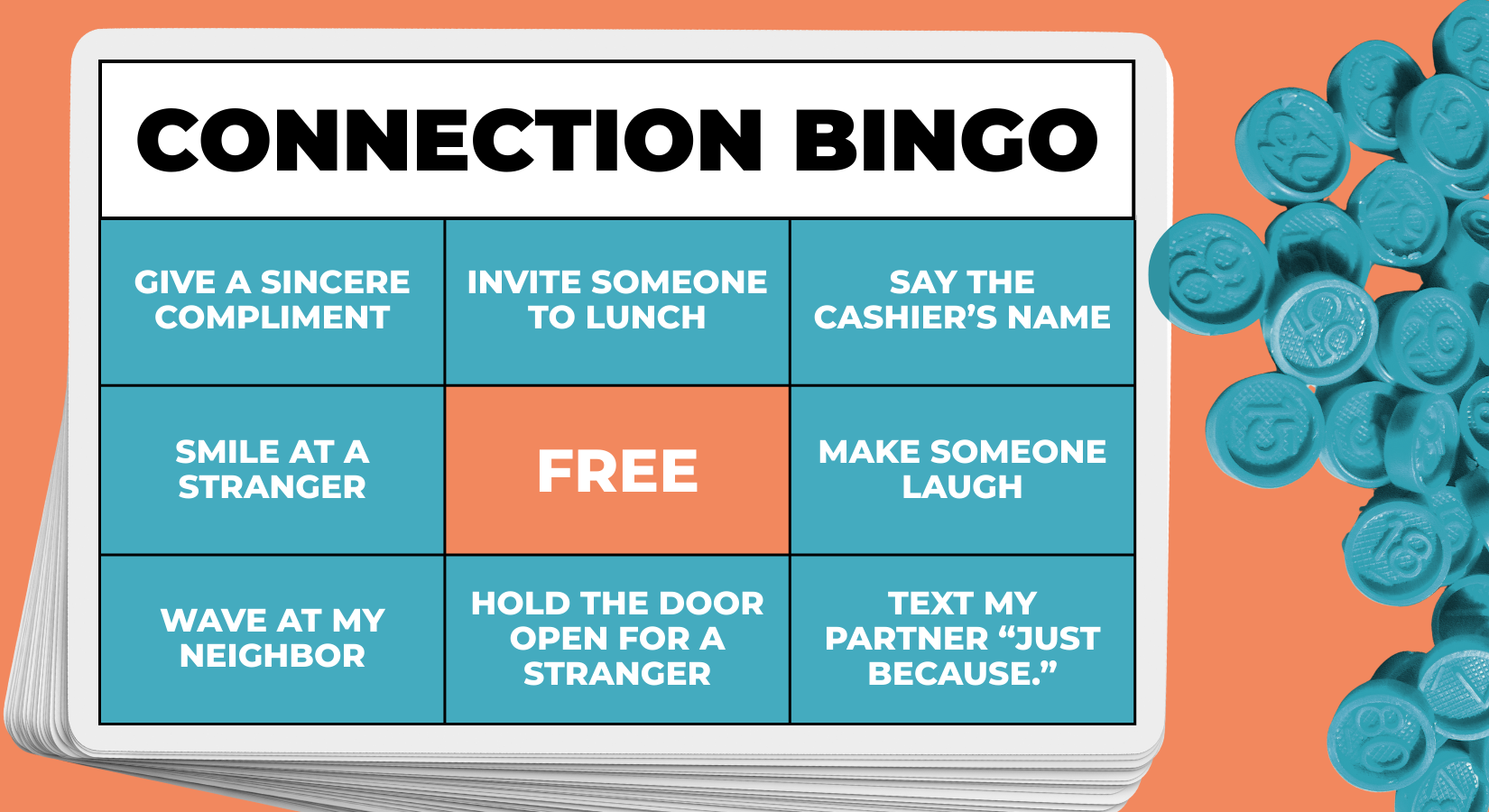
1. Connection Bingo
I know. This first one’s kinda silly, but why not have some fun. Make a quick Bingo-style grid (3×3 will do) and fill each box with a small, doable connection act. Example squares: Give a sincere compliment. Text my partner “just because.” Wave at my neighbor. Say the cashier’s name. Smile at a stranger. Invite someone to lunch. Then try to get “Bingo” before the end of the week!
2. The 2-minute rule (relationship edition)
Spend just two extra minutes a day strengthening a relationship: send a quick “hey what’s up” text to your cousin, send a snail-mail birthday card to your friend (hurray for old school!), or drop a voicemail to your mom that says, “Hey, I’m thinking of you.” Those micro-moments add up.
3. Practice public kindness
Be visibly kind in public. Hold a door. Offer to help. Give another driver that closest parking spot at the bank. Speak gently. When people see kindness, it reminds them we’re in this together. What’s more, it can start a ripple effect, and you never know who really needed that tiny spark of warmth.
4. Ask a better question
Instead of, “How are you?” try, “What’s been the highlight of your day so far?” or “What’s something that made you laugh this week?” You’ll be amazed how fast that small shift can deepen your connection.
5. Start a “we” section in your journal
Every night, jot down one moment where you felt connected to someone else – big or small. It helps rewire your brain to notice connection in action. (Bonus: journaling in general is good for your brain!)
A world that works better when we work together
When we shift our focus from “me” to “we,” we open ourselves up to deeper relationships and shared experiences. Collaboration can spark creativity, mutual support can ease burdens, and communal celebrations can amplify joy.
So, maybe today, instead of asking, What do I need to do to get ahead?, we could try asking, How can I help someone else? Who could use a kind word? Who’s feeling invisible right now? And wow… doesn’t that sound like a nicer world to live in?