

What psychology says helps – and the one thing that helped me (yes, me) the most
Recently, back in December, a person I loved and trusted hurt me deeply.
This wasn’t a glancing blow. Not a misunderstanding or an awkward moment that stung for an hour or two. This was the kind of hurt that landed solidly, brought me to a halt, and affected my sleep, my focus, and my sense of equilibrium.
I’m a psychologist. I’ve spent years helping people work through emotional pain – betrayal, disappointment, loss, broken trust. I know the research. I teach the tools. I’ve watched countless clients move from raw hurt to steadier ground using approaches that are well supported in the psychological literature.
This time, though, I wasn’t guiding someone else through it. This time, I had to figure it out for myself.
Before we continue, I want to say this clearly: I’m OK. I’m strong. I have excellent coping and recovery skills. But still… what a journey.
It felt a bit like finding myself in an unanticipated (and unwanted) human behavior experiment, with me as the sole subject. So, being a scientist, I decided I might as well learn from it – and, hopefully, pass along some of my hard-earned insights. Now that I’ve gained some distance and perspective, I’m ready to share what I learned.
Let’s look at the most common, research-backed ways people recover from emotional hurt: what they’re designed to do, why they work, and, candidly, whether they worked for me. Then I’ll share the one intervention that turned out to be more beneficial than anything else.
The psychology toolkit for emotional pain
Psychology doesn’t lack for advice when it comes to being hurt. We have a full toolkit of practical, evidence-based strategies designed to help people process pain, regain emotional balance, and move forward.
None of them are magic. All of them have merit. And like most things in human behavior, there’s no one-size-fits-all solution. Their effectiveness depends on the person using them.
Here are six of the most common.
1. Journaling: Writing it out to work it out
Expressive writing – writing about your deepest thoughts and feelings related to a stressful or emotional event – is one of the most frequently recommended techniques for emotional processing.
A large body of research, originating with James Pennebaker in the 1980s, shows that this kind of writing can produce measurable benefits for both emotional and physical well-being. Study participants who were directed to write about emotional experiences for several consecutive days later reported improved mood, fewer health-center visits, and even better immune functioning compared with those who wrote about neutral topics.
In theory, journaling helps us offload emotion, identify patterns, and gain perspective. It organizes chaotic internal states into a coherent narrative – something the brain is particularly good at using to heal.

Did it work for me?
Honestly? I’m not much of a journaler. I respect the technique, recommend it often, and have seen it help countless people… but it’s never been my go-to. I didn’t journal this time, and I didn’t feel worse for skipping it.
(Please let me emphasize: journaling works wonderfully for many people. If it works for you, absolutely keep using it. It’s a valid and effective healing tool.)
2. Talking out loud (even when no one’s around)
There isn’t a towering stack of randomized trials proving that speaking your feelings into an empty room will definitely make you feel better, but neuroscience and clinical psychology point in the same direction: naming emotions matters.
Research on what psychologists call affect labeling shows that putting feelings into words – spoken or written – engages emotion-regulation systems in the brain and reduces emotional intensity.
Why? Because verbalizing emotion engages different neural pathways than silent rumination. Naming feelings gives structure to experience. It turns emotional noise into something the mind can work with.

Did it work for me?
Oh wow – yes. I did a lot of talking. Out loud. While driving, walking, doing laundry. Sometimes calmly, sometimes emphatically, sometimes repeatedly. It helped me hear myself think, identify what hurt, and separate emotion from fact.
3. Allowing anger as a valid waypoint (without taking over permanently)
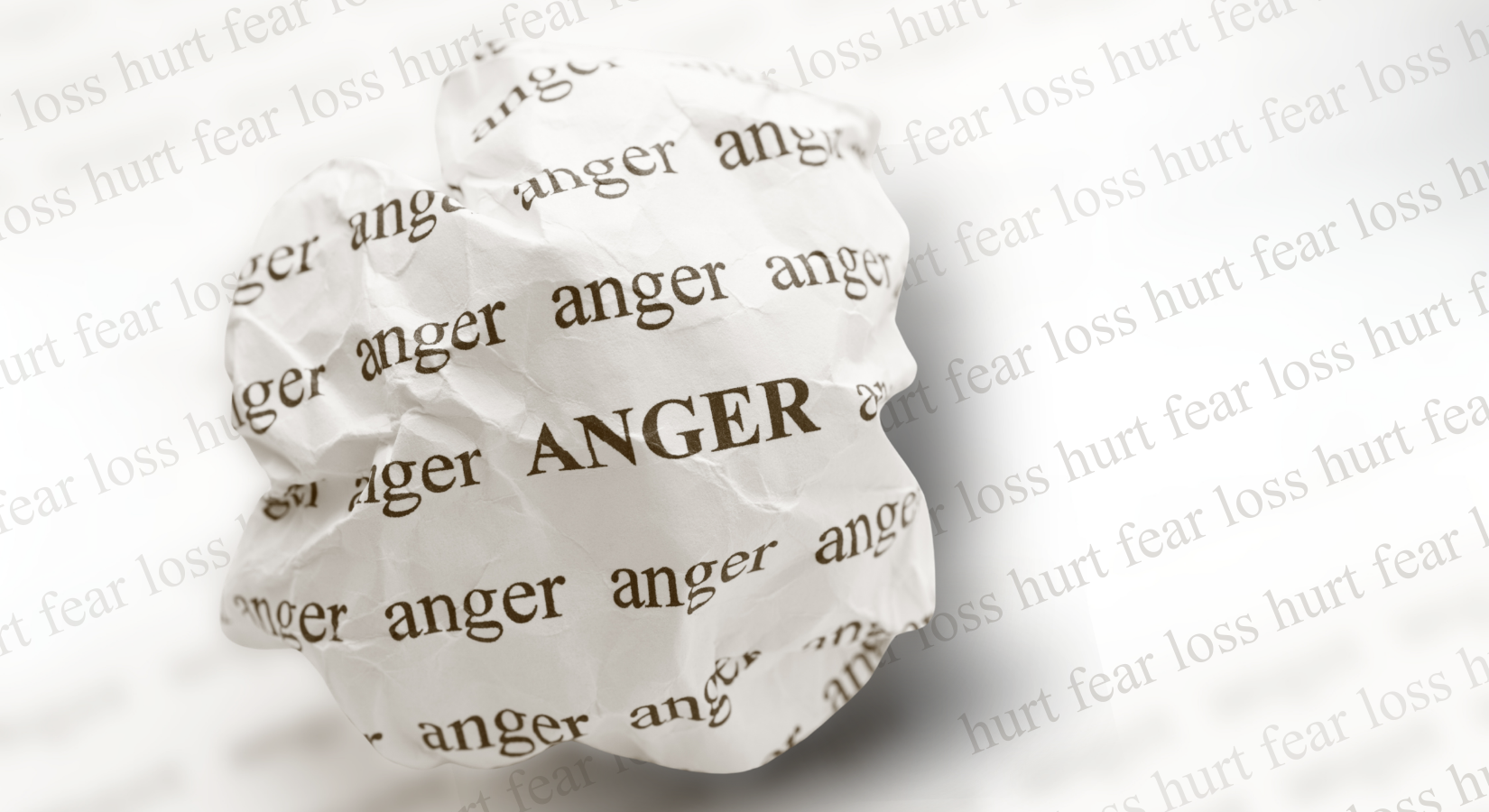
Anger gets a bad reputation, but psychologically speaking, it’s often a secondary emotion – one that arises in response to deeper feelings like hurt, fear, or loss.
Anger can signal that a boundary was crossed or that something mattered deeply. When acknowledged and worked through (rather than denied or suppressed), research from emotion-focused therapies shows that people often experience reductions in long-term emotional distress.
Did it work for me?
Yes, but with boundaries. I’m rarely angry by nature, so it isn’t my default emotional response. Still, I allowed myself to feel anger without feeding it or acting on it. I didn’t suppress it, and I didn’t let it take over the narrative.
Handled this way, anger gave me information without running the show.
4. Talking to trusted people: Borrowing calm from others
Social support is one of the most consistent predictors of emotional recovery in psychological research. Humans evolved as deeply social creatures, and supportive conversation with empathic others helps regulate emotion in ways solo coping cannot.
When someone you trust reflects understanding, presence, or validation, emotional pain becomes more manageable. Evolutionary psychology even frames interpersonal emotion regulation as one of the core reasons humans talk to one another! We are built to repair one another’s emotional distress.
Put simply: sharing your pain helps to manage it.

Did it work for me?
Absolutely. Talking with people I trust helped me stay grounded, reality-check my thoughts, and feel less alone. It didn’t erase the pain, but it made it bearable. And that matters more than we sometimes realize.
(I remain immensely grateful for my people. You know who you are.)
5. Cognitive reframing: Perspective without denial
Cognitive reframing – gently shifting how we interpret or contextualize an experience – is central to many evidence-based therapies, such as cognitive behavior therapy. It doesn’t minimize hurt or pretend things didn’t matter. Instead, it allows space for meaning-making and integration. Reframing helps us fold painful experiences into our life story rather than letting them define it.
Did it work for me?
Yes, but only later. Once the emotional intensity eased, reframing helped me see the situation more clearly and place it within the broader story of my life.
6. Taking action: Restoring a sense of agency
One of the most destabilizing aspects of being hurt by someone you trust is the loss of control. When trust is broken, it often leaves people feeling powerless, exposed, or emotionally unsafe.
Psychology has a word for the antidote to that feeling: agency, which is defined as the sense that we can influence what happens next.
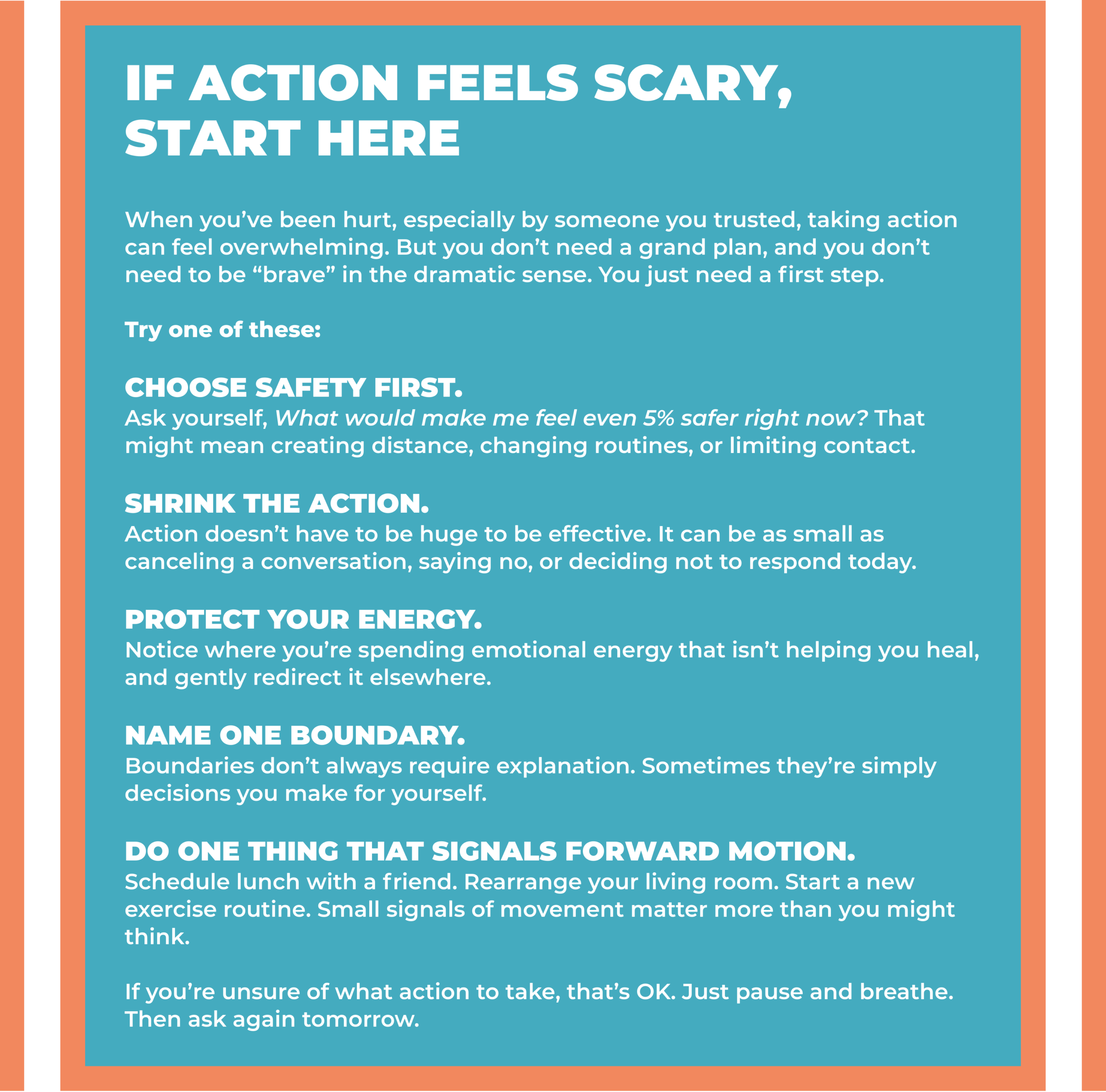
Research on coping and trauma consistently shows that taking purposeful action, even small action, helps regulate emotion, reduce helplessness, and restore psychological equilibrium. Action shifts us out of passive suffering and back into participation in our own lives.
Importantly, this doesn’t mean reacting impulsively or dramatically. It means choosing a step – sometimes a very quiet one – that protects, stabilizes, or moves you forward.
Did it work for me?
Yes. Profoundly. In my case, taking action meant protecting myself from further harm by removing the person who hurt me from my life. That wasn’t done in anger or haste. It was a measured, self-protective decision. And once I made it, something important happened: Almost instantly, I felt safer.
That sense of safety mattered more than I expected. It told my nervous system, I’m paying attention and I’m taking care of myself.
In other situations, taking action might look very different. It could mean:
- setting or enforcing a boundary
- asking for clarity or accountability
- changing routines that keep reopening the wound
- seeking professional support
- redirecting energy toward something meaningful or restorative
- deciding not to engage further, even without closure
The specific action matters less than the message it sends to yourself:
I have agency. I can choose what happens next.
What doesn’t help (and why psychology moved away from it)
For decades, people were encouraged to “get anger out” by screaming, yelling, breaking objects, or beating pillows. This idea, called emotional catharsis, was once widely accepted.
But more recent research has shown that venting anger through aggressive expression doesn’t reduce emotional pain. It often intensifies it.
Studies consistently find that physically acting out anger increases physiological arousal, reinforces angry thought patterns, and keeps the nervous system activated rather than calming it. In other words, practicing anger tends to make people better at being angry – not better at healing.
That’s why modern psychological approaches emphasize acknowledging anger without amplifying it. Feeling anger is human. Acting it out is counterproductive.
The intervention no one wants to hear about (and the one that helped me most)
And then there’s the strategy almost no one finds satisfying in the moment.
Time.
Time isn’t avoidance or denial, and it certainly isn’t “doing nothing.”
Time allows the nervous system to recalibrate. It gives emotions room to soften. It lets sharp edges wear down so the pain no longer flares every time the memory brushes past.
There’s no clinical trial that reveals the exact number of days required to heal, because that’s not how human neurobiology works. But there is extensive research showing that emotional intensity naturally diminishes as the brain processes and integrates painful experiences.
For me, the simple passage of time continues to be the single most powerful factor in healing.
I’m not rushing, because I simply can’t. I’m not pressuring myself to “be over it.” I’m staying engaged with life and letting the days pass. And slowly, the hurt is starting to lose its grip.

What I hope you take from this
If you’re hurting right now – especially if it’s because someone you trusted let you down – there’s nothing wrong with you for still feeling it. This is what emotional injury looks like when it’s working its way through your system.
Some things help. Some don’t. You’ll probably use a few tools, ignore others, circle back to some later, and change your mind along the way. What matters most is that you stay engaged with your life while the pain slowly recalibrates. Protect yourself where needed, and allow emotions to move through you, rather than trying to outrun or amplify them. And be sure to give yourself time – not as a passive, do-nothing strategy, but as an active process your brain and nervous system are already equipped to handle.
Here’s my personal conclusion: The hurt doesn’t disappear. But it changes. Once you gain the perspective of time, it becomes information you need to learn and grow. It becomes part of your story… just not the headline.
This is an amazing article and so helpful. You walk the talk !