
How your brain predicts your world – and how to improve the forecast
Attention: geeky science article alert! (Stick with me… you’re going to love this.)
Your brain is a prediction engine.
Right now, as you read this, your brain is quietly guessing what word comes next. It’s estimating how long this sentence will be, predicting how your body might shift in your chair, anticipating how your coffee will taste when you take another sip, and deciding whether that sound you just heard in the other room is something important, or something you can safely ignore. None of this requires effort on your part, and yet it’s happening constantly.
And here’s where things get especially interesting. According to one of the most influential frameworks in modern neuroscience – often called predictive processing or Bayesian brain theory – this isn’t just one of the many things your brain does… it may very well be the main thing it does.

Researchers at institutions such as University College London, along with neuroscientists like Karl Friston*, suggest that your brain is continuously building and updating a working model of the world. In other words, rather than waiting for reality to arrive and then reacting to it, your brain is running a moment-by-moment simulation of what it believes is happening and what is likely to happen next.
Incoming sensory information is compared to that simulation, and when everything lines up, the world feels seamless and correct. But when something doesn’t match, the brain generates what scientists call a prediction error – a subtle internal signal that says, “That’s not what I expected” – and then adjusts the model accordingly.
So, in a very real sense:
You don’t experience reality. You experience your brain’s best guess about reality.
That idea can feel a little freaky at first, but once you embrace it, it starts to explain an astonishing number of everyday experiences.
Your brain isn’t passively observing reality – it’s betting on it
Think about how you can walk into your kitchen in the dark and somehow avoid the chair, the counter, and the dog bowl. Or how you reach for your phone before it even finishes buzzing. Or how you begin to say, “What was that?” to someone, only to answer your own question a split second later because you’ve already figured out what they meant. These moments feel ordinary, but they’re actually remarkable. They reveal that we are not simply reacting to the world around us. Rather, we are predicting it, continuously, automatically, and with impressive accuracy.
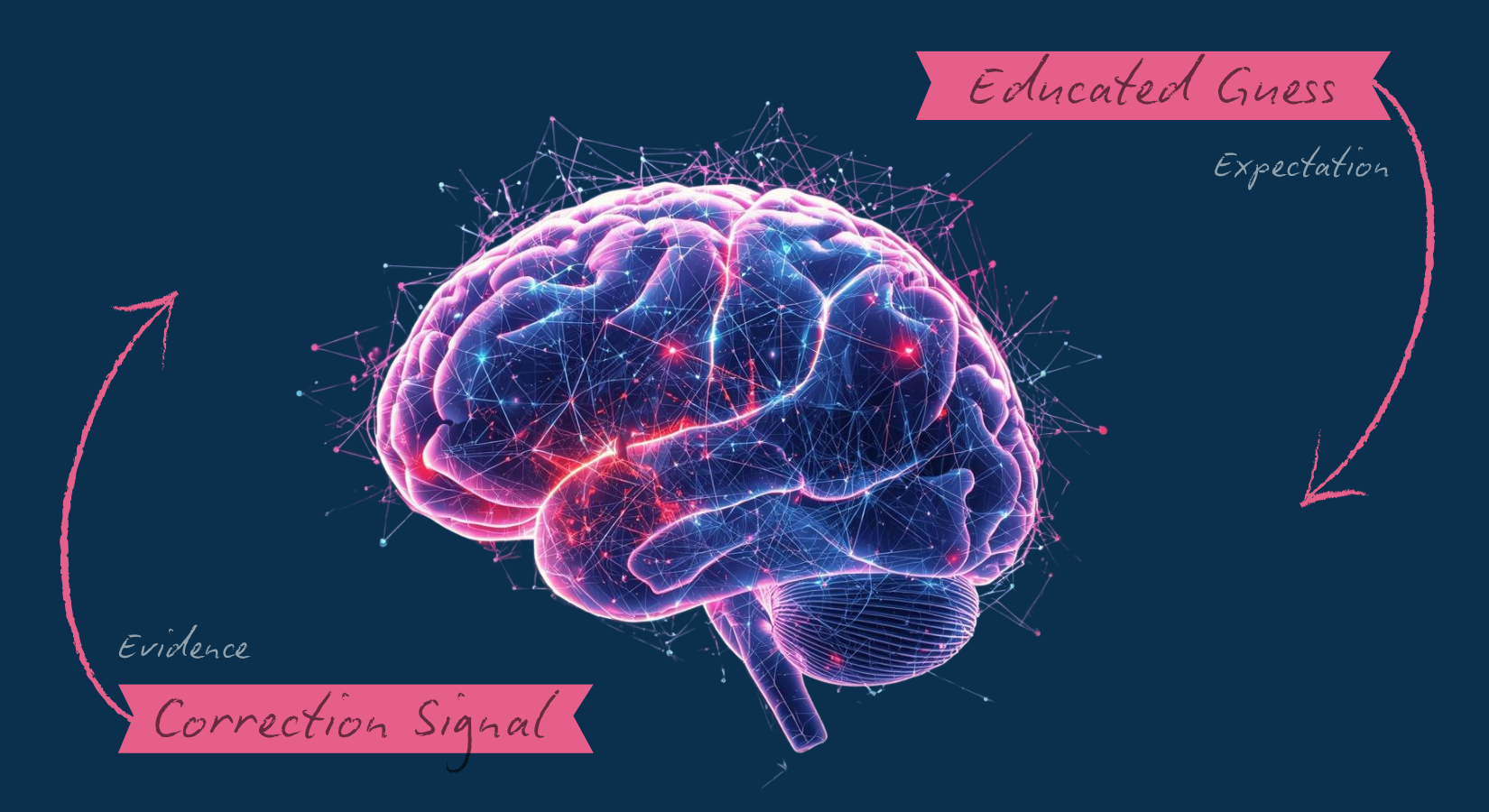
For many years, we were taught to think of the brain as something like a recording device, taking in sights and sounds and assembling them into a picture of reality. Predictive processing turns that idea on its head. The brain is better understood as a kind of simulation engine, constantly generating possibilities and then checking those possibilities against incoming information.
Neuroscientists refer to this as a generative model – a layered, evolving set of expectations about how the world works, ranging from basic predictions about movement and balance to complex expectations about relationships, meaning, and even our sense of self.
A helpful way to picture this is to imagine that your brain is engaged in an ongoing internal conversation. Higher-level areas are sending down educated guesses about what is likely happening, while lower-level sensory systems are sending back correction signals when something doesn’t quite fit.
Perception, in this sense, is not a one-way flow of information but a continuous loop – a back-and-forth dialogue between expectation and evidence. When that loop is running smoothly, everything feels effortless and natural, which is precisely why we rarely notice it at all.
Why your brain loves being right
Most of the time, your brain’s predictions are so accurate that they are indistinguishable from reality itself. You don’t experience a collection of colors and angles; you experience a chair. You don’t hear vibrations in the air; you hear your best friend’s voice. The brain has predicted these patterns so successfully that they feel immediate and obvious.
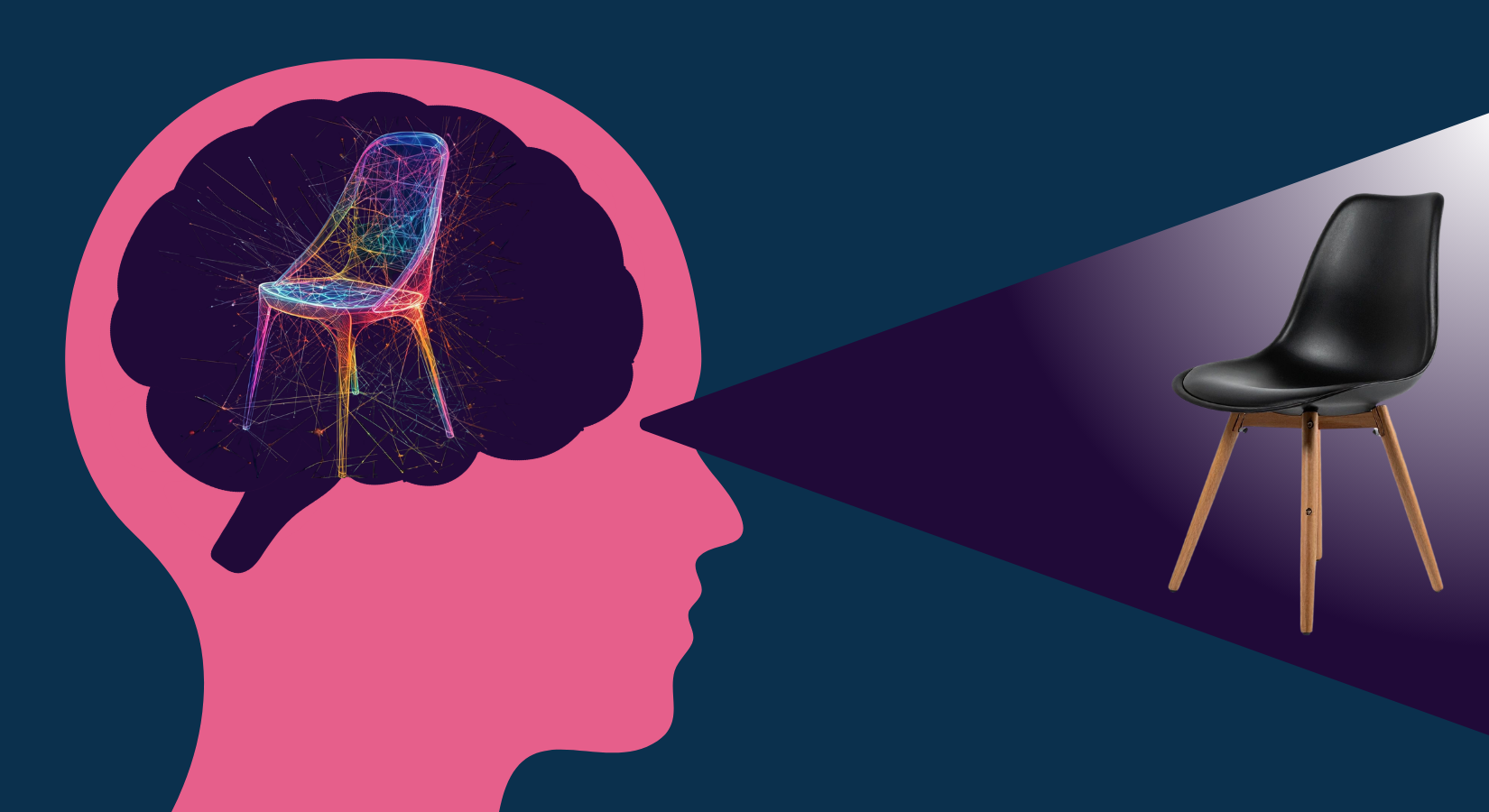
This efficiency also explains why you can move confidently through familiar environments while thinking about something else entirely, or drive a well-known route and suddenly realize you don’t remember the last several turns. It’s not that your brain checked out; it simply didn’t need to call your attention to the details.
This same system also explains why learning something new can feel awkward at first. When your brain’s predictions are not yet accurate, the resulting prediction errors are larger and more noticeable. With practice, those errors shrink, and what once required effort begins to feel natural. In this framework, learning is much more than simply acquiring information – it’s about gradually reducing surprise!
The confidence dial in your head (and why your phone just “buzzed” when it didn’t)
This fascinating prediction process also involves something researchers call precision, which you can think of as the brain’s internal confidence dial. Your brain doesn’t treat all information equally. When sensory input is clear and reliable, like in bright daylight, it gives that information more weight. When the situation is uncertain, or when incoming data is noisy or unfamiliar, it leans more heavily on what it already expects to be true.

This helps explain a wide range of everyday experiences. We trust what we see in good lighting but feel uneasy in a dim parking lot. We rely more on habit when we’re tired. We confidently sing along (ahem… incorrectly) to song lyrics we’ve misheard for years because our brain assigned such high confidence to its original prediction that it continues to use it.
This also explains why, when we’re waiting for an important message, we might swear we felt our phone vibrate, even when it didn’t. Our brain isn’t malfunctioning; it’s making a highly confident prediction based on what it expects to happen.
You don’t just predict the world – you nudge it
Perhaps the most surprising part of this framework is that your brain doesn’t just update its internal model – it also subtly shapes your behavior so that your experience will better match what it predicts. This process, known as active inference, means that action and perception are deeply intertwined.
If your brain predicts that you’ll be cold, you reach for a sweater. If it predicts that a conversation will be uncomfortable, you rehearse what you might say. If it predicts that you’re about to lose your balance, you shift your weight before you’re even aware of it. We’re not passive observers of reality; we’re active participants, constantly moving in ways that help our predictions come true, or help us gather better information when they don’t.
Seen through this lens, many everyday experiences take on new meaning. A familiar smell can instantly transport us back decades because the brain’s model for that sensory pattern is richly connected to memory. The sense that something “feels off” often reflects a prediction error that hasn’t yet reached conscious awareness.
Worry: your brain’s overprotective parent
Worry has a terrible public relations team. It isn’t necessarily a flaw. In many cases, it’s simply prediction with the volume turned up. If your brain’s job is to anticipate what comes next so you can survive, it makes perfect sense that it sometimes overshoots and begins generating worst-case scenarios. From an evolutionary standpoint, a brain that occasionally worried unnecessarily was far more useful than a brain that missed real danger.

Research from the University of California, Berkeley has shown that uncertainty itself increases activity in brain regions associated with threat detection. The brain prefers a negative prediction over no prediction at all, because at least a bad guess feels actionable.
That’s why your mind may replay stressful conversations at 2:00 a.m., imagine outcomes that haven’t happened, or prepare for problems that may never exist. Your brain isn’t trying to make you anxious; it’s trying to protect you! In that sense, worrying is an attempt – sometimes an overzealous one – to reduce uncertainty.
Calm, explained by neuroscience (and it’s not what you think)
The encouraging news is that this same predictive system can also help us understand calm in a very different way. Rather than thinking of calm as the absence of brain activity, think of it as the presence of accurate prediction. When your brain feels reasonably confident about what’s happening – even if what’s happening is busy or complex – your nervous system tends to settle.

This is why routines can feel soothing, planning can reduce stress, and familiar environments can bring a sense of ease – your brain functions well when prediction error is low.
So, if you want to feel calmer, the goal is not to eliminate uncertainty, which would be an impossible task. Instead, the goal is to help your brain make better predictions. That might mean giving it more accurate information, creating gentle and repeatable patterns, or preparing in realistic ways rather than catastrophizing.
When your brain gets a little… stuck
This perspective also offers a very practical way to think about psychological well-being.
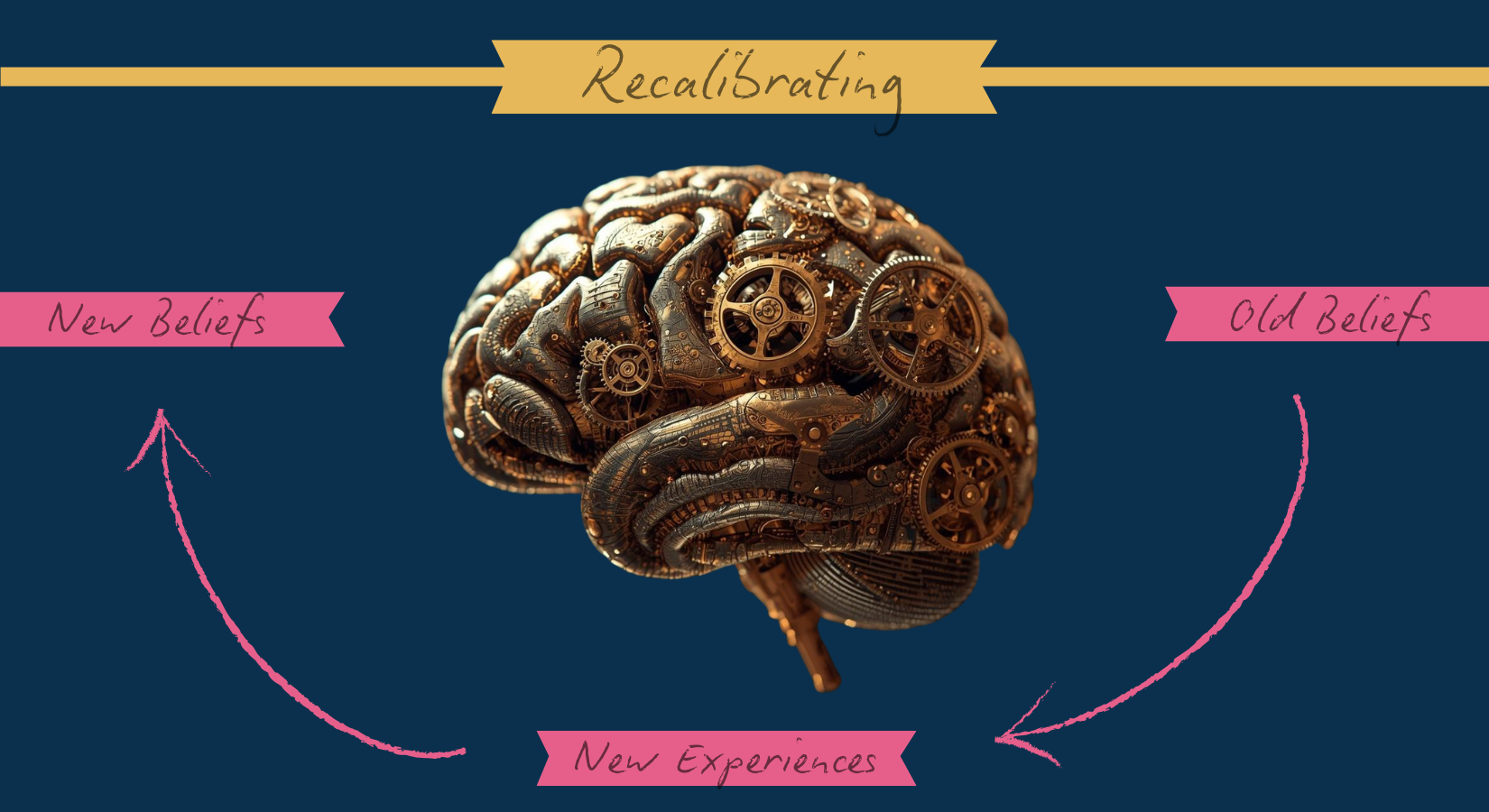
Sometimes, the system becomes a bit too efficient. When prior beliefs are given too much weight (that internal confidence dial turned way up), the brain can become resistant to updating – even when new information clearly suggests it should. In other words, the model becomes rigid.
This is how we can get stuck in patterns that no longer serve us.
If your brain has learned, for example, “I’m not good at this,” or “People can’t be trusted,” or “This always goes badly,” it may continue to generate predictions that reinforce those beliefs, even when reality offers contradictory evidence. You may overlook positive feedback, misinterpret neutral interactions, or avoid situations that could have updated your model.
On the flip side, when incoming information is treated as overly important (when that confidence dial swings the other way), everything can feel unpredictable and overwhelming. The world starts to feel noisy, unstable, and difficult to interpret.
In both cases, the issue isn’t that the system is broken. It’s that it’s miscalibrated.
Growth, in part, involves gently recalibrating what we trust. It means allowing new experiences to update old beliefs, while still relying on stable knowledge when appropriate. It also means becoming aware of the predictions we’re carrying into situations. Because once you notice them, you can begin to question them, and that’s where positive change starts.
DO try this at home: train your prediction machine
If you’d like to see this process in action, try changing something small in a familiar environment. Move an object in your kitchen or office, and then later notice how your hand automatically reaches for its old location.
That brief moment of surprise? That’s a prediction error! And the next time you reach for the object, your brain will already have updated its model.
You can observe the same thing when learning a new skill or even a few words in another language. At first, it feels awkward, but very quickly it begins to feel natural as your predictions improve. Even pausing in those moments to think, “My brain just learned something!” can transform confusion into a small moment of growth.
Your brain: the quiet genius working ahead of you
The more we understand predictive processing, the more extraordinary ordinary life begins to look. Each time you move confidently through a dark room, understand a joke before the punchline is finished, or sense that something in your environment isn’t quite right, you’re witnessing, firsthand, your brain’s powerful predictive ability at work.
Rather than simply reacting to the present moment, your brain is constantly trying to take care of you by anticipating what comes next, and by refining your understanding when reality surprises you.
It’s a quiet process, energy-efficient and largely invisible, and it’s happening for you all day, every day. Your brain is, in the most literal sense, helping you to meet and understand the future. Pretty cool, huh?
* And I still can’t get over this: I was deep in the research rabbit hole on Bayesian brain theory – completely fascinated by Karl Friston’s work – when I discovered I’ll be attending a conference with him in May. And… we’re going to have lunch together!
I feel just like a starstruck groupie. Yes, I will absolutely try to play it cool. (And no, I will probably fail.)